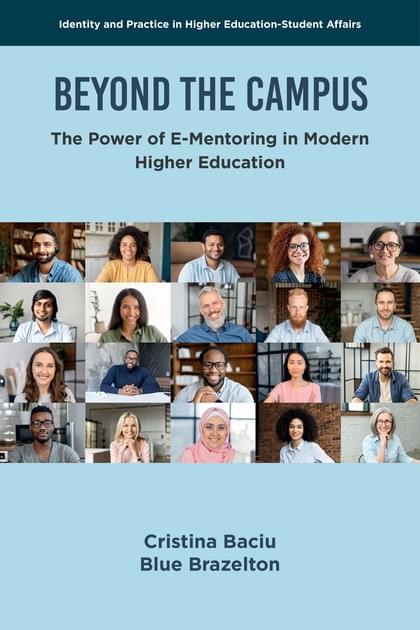
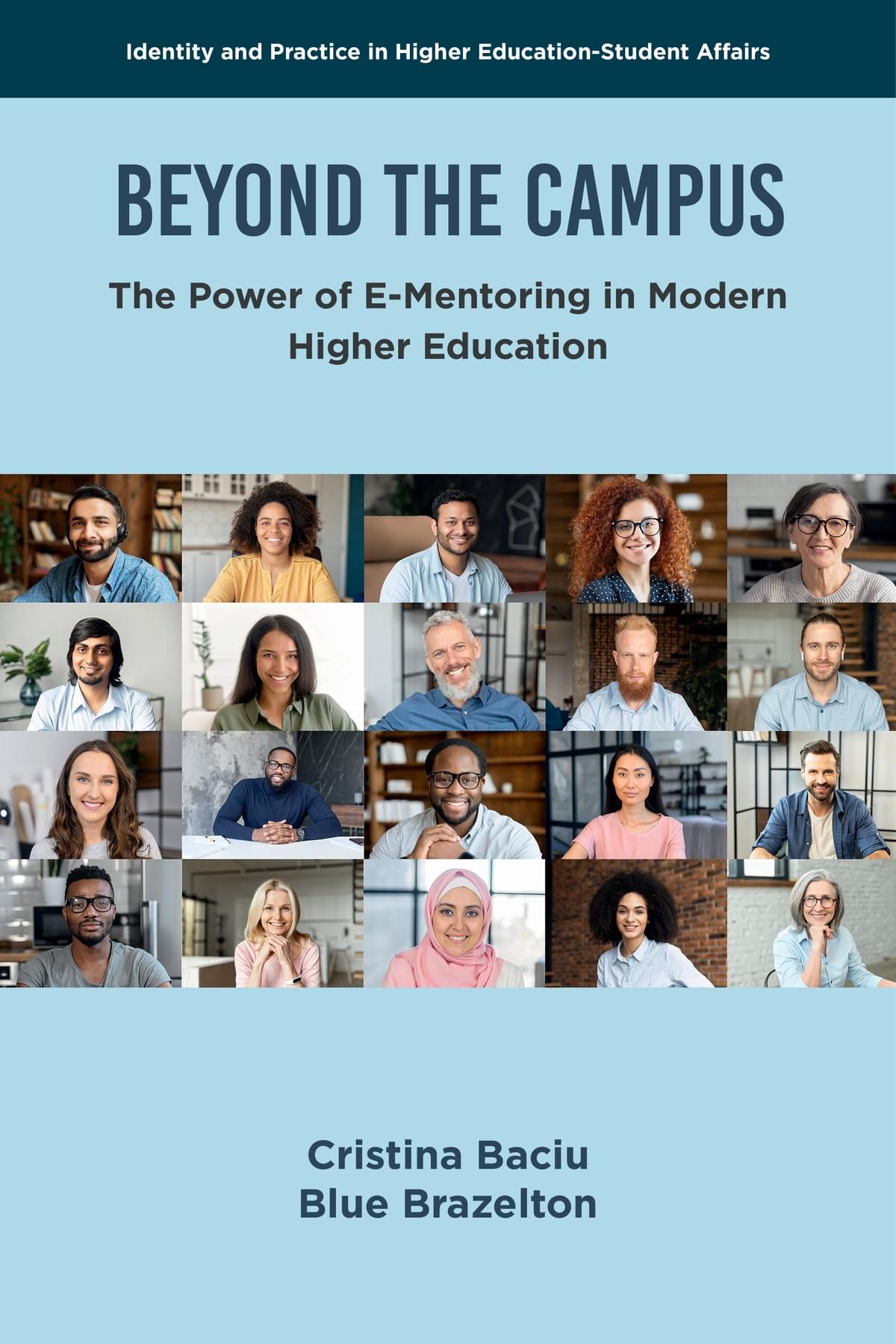
Mentoring should not be left to chance.
Beyond the Campus: The Power of E-Mentoring in Modern Higher Education shows how colleges and universities can design mentoring as essential infrastructure for student success, belonging, and opportunity.
By Cristina Baciu & Blue Brazelton
Forthcoming from Emerald Publishing
Digital release: October 13, 2026
Print release: November 3, 2026
Endorsements
National leaders and scholars reflect on the book’s contribution to mentoring, student success, belonging, and the future of higher education.
Lynn Pasquerella
President of the American Association of Colleges and Universities
"Beyond the Campus makes a compelling case that mentoring is no longer a supplemental benefit of higher education but an essential strategy for advancing student success, belonging, and equity. Baciu and Brazelton offer a timely, research-informed roadmap for reimagining mentoring in ways that meet the needs of today's learners and strengthen higher education's public purpose."
Leo M. Lambert
President Emeritus, Elon University, and co-author, Relationship-Rich Education: How Human Connections Drive Success in College
"This book, both compelling and useful, seeks to close a significant gap in higher education by ensuring that digital learners form the human connections and deep personal relationships that are foundational to academic success and human development and transformation. Professor Baciu and Brazelton write with clarity and heart and create a hopeful vision for the future of digital learning that centers the importance of mentoring and relationships in virtual spaces."

Olena Zhadko, PhD
Chief Online Learning Officer and University Associate Dean of Online Education, The City University of New York (CUNY)
"Digital learning can expand access, but access without connection is not enough. As higher education increasingly reaches learners beyond the traditional campus, we have a responsibility to design not only for access, but for belonging, connection, and success. Beyond the Campus offers an important and timely vision for making meaningful mentoring part of the very fabric of modern higher education. Grounded in research and thoughtfully translated into practice, this book challenges us to think differently about how we create the human connections that help learners thrive—wherever learning happens."
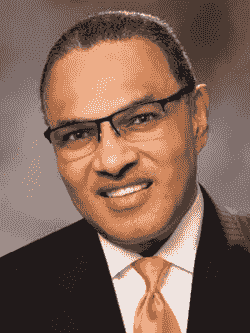
Freeman A. Hrabowski III
President Emeritus of UMBC
The University of Maryland, Baltimore County
"This book is especially timely as educators work to address the needs of the increasingly diverse online student population, including first-generation and non-traditional learners. More than ever, colleges and universities must build strong connections with students through effective mentoring and learning communities. Readers will be impressed by the rich blending of research and insights derived from practical experience. The book encourages readers to broaden their thinking about how best to serve students."

W. Brad Johnson, PhD
Professor Emeritus of Leadership, Ethics, and Law
United States Naval Academy
"The future of higher education is digital. More of our students are part-time, online, and juggling employment and caregiving with education. So how do those of us committed to rich developmental relationships with students meet this moment? In Beyond the Campus, thought-leaders Cristina Baciu and Blue Brazelton offer a powerful roadmap to fostering trust, building belonging, and sharing social capital, even as we mentor through screens and across time zones. Choc full of case studies, e-mentoring tactics, and strategies for program leaders, this is the definitive guide to e-mentorship in higher education."

Gloria Crisp
Associate Dean and Professor of Adult and Higher Education
College of Education, Oregon State University
"Beyond the Campus turns the promise of e-mentoring into practice. The authors' thoughtful guidance, useful reflection questions, and actionable resources will benefit faculty and staff working with students at every stage of the college journey."

Stacy Blake-Bear, Ph.D.
Clinical Professor, Tuck School of Business, Dartmouth College
"Beyond the Campus: The Power of E‑Mentoring in Modern Higher Education is a timely and insightful exploration that masterfully bridges established mentoring wisdom with the evolving world of digital connection. This book not only enhances our current understanding of e‑mentoring; it positions e‑mentoring as a powerful vehicle for expanding access, strengthening belonging, and deepening psychological safety in digital spaces. Drawing on theoretical, empirical, and practical lenses, it ventures into uncharted territory with clarity and care—broadening what we know about how e-mentoring can thrive. With its practical insights on launching, sustaining, and evaluating e‑mentoring programs, this book is an invaluable asset for mentors, educators, and institutions committed to innovative and inclusive mentoring."

Dr. Tia Brown McNair
Author of Becoming a Student-Ready College: A New Culture of Leadership for Student Success and From Equity Talk to Equity Walk
"The growing utilization of e-mentoring represents an important evolution in how higher education fosters student success in an increasingly connected and diverse world. This must-read book provides an overview of essential components for designing high-quality, equity-focused e-mentoring models that support students’ academic, personal, and professional growth. Building the capacity of educators to deliver on the promise of this student support strategy will yield lasting benefits for the future of higher education."
Who This Book Is For
Beyond the Campus is for higher education professionals who believe that student success depends not only on courses, credentials, and services but also on relationships. This book is especially useful for people working to make mentoring more intentional, accessible, equitable, and sustainable across today’s complex educational environments.
Higher Education Leaders
For deans, associate deans, department chairs, directors, and senior administrators thinking strategically about student success, retention, belonging, and career readiness.
This book helps leaders consider mentoring not as an isolated program, but as part of the larger infrastructure students need to navigate college successfully.
Student Affairs Professionals
For practitioners supporting students through advising, belonging initiatives, leadership development, identity-based programs, career pathways, and transition points.
The book offers language and strategies for designing mentoring experiences that meet students where they are — especially when students are navigating institutional complexity, uncertainty, or limited access to informal networks.
Faculty Mentors and Academic Advisors
For faculty, advisors, and academic staff who want to support students more intentionally without assuming mentoring has to happen only through traditional, in-person relationships.
This book helps mentors think about trust, expectations, communication, boundaries, and the kinds of guidance students may need but may not know how to ask for.
Online, Hybrid, and Digital Learning Leaders
For those designing programs for students who may never experience the campus as their primary site of connection.
The book is especially relevant for online programs, hybrid degree pathways, adult learners, working students, transfer students, and geographically dispersed learners who need meaningful support beyond physical proximity.
Mentoring Program Designers
For anyone building, managing, assessing, or redesigning formal mentoring programs.
This includes those responsible for mentor–mentee matching, training, communication plans, program evaluation, and long-term sustainability. The book helps move mentoring programs beyond the match and toward the conditions that make mentoring relationships actually work.
Graduate Program Directors and Faculty Supporting Graduate Students
For leaders supporting graduate students through academic, professional, and identity-based transitions.
Graduate students often need multiple forms of mentoring: scholarly guidance, career preparation, professional socialization, emotional support, and access to networks. This book offers a way to think more intentionally about those layers of support.
Centers, Institutes, and Professional Associations
For teaching centers, career centers, honors colleges, research centers, professional associations, and grant-funded initiatives that want to build mentoring into their programming.
The book can support conversations about how to scale meaningful relationships without making mentoring feel generic, transactional, or overly automated.
About the Authors

Cristina Baciu, Ed.D
Dr. Cristina Baciu is a mentoring researcher, educator, and higher education leader. Her work explores how relationships help people navigate complex systems, from universities to healthcare. She serves as Assistant Director of Research at the W. P. Carey School of Business at Arizona State University, where she works with faculty and institutional leaders to strengthen research development, collaboration, and mentoring initiatives across disciplines. Originally from Romania, Cristina’s work reflects both scholarly inquiry and lived experience navigating educational systems across cultures and institutions. She continues to mentor students and early-career professionals and believes deeply in mentoring as a powerful tool for expanding opportunity and helping people realize their potential. Learn more about her work by visiting her website here.

Blue Brazelton, Ph.D
Dr. Blue Brazelton is an Associate Professor of Higher Education Leadership at Northern Arizona University, where he teaches and studies leadership and organizational behavior, often as it relates to the digital aspects of higher education. With over 20 years of experience in teaching and mentoring (delivering both through in-person, hybrid, and online modalities) and numerous publications on the intersection of education and technology, he encourages mentoring as an educational priority regardless of transactional distance. He has mentored, and continues to mentor, current and former graduate students, newer faculty, and, more recently, high-achieving neurodivergent professionals in various fields. Thanks to the realized power of e-mentoring, he often has his mentoring calls in the forest. Learn more about his work by visiting his website here.